When you have total knee replacement (TKR) surgery, recovery and rehabilitation is a crucial stage. In this stage, you’ll get back on your feet and return to an active lifestyle.
The 12 weeks following surgery are very important for recovery and rehab. Committing to a plan and pushing yourself to do as much as possible each day will help you heal faster from surgery and improve your chances for long-term success.
Halley Orthopedic Products was founded in Southeast Michigan in 2005. The company’s objective was simple: improve the results of knee surgery through new rehabilitation technology. The result of years of research and development was the first model of the X10 Knee Rehabilitation Machine in 2011. Since then many thousands of knee patients have recovered using the X10™.
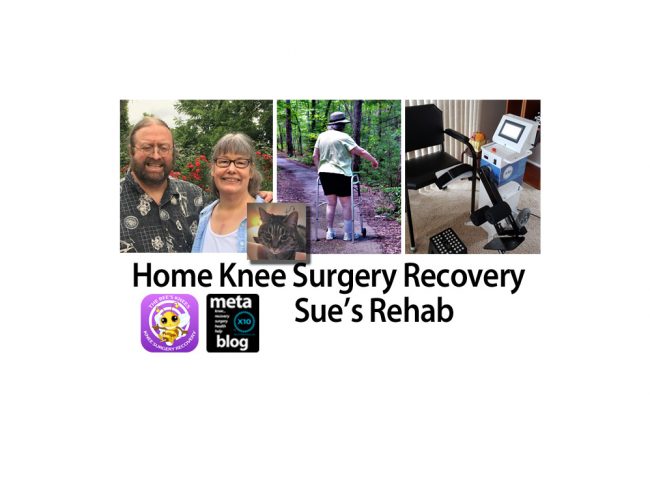
My experience with the X10 began one rainy afternoon in April, 1974. My boyfriend and I (now husband of 44 years) were riding his motorcycle when we were broadsided by a car. I remember the impact, sliding on the wet pavement towards the intersection.
Your recovery after knee surgery gets into full gear a few weeks after surgery when you can use a stationary bike at home or at the gym. Getting the Most Out of a Stationary Bike After Knee Surgery by Mike McClellan.
Jeff, 60, had a knee replacment. Recovery afterwards did not go well. He elected to use the X10 Knee Machine for his Recovery after MUA. Listen to the podcast or read the interview here.
I must admit there was a certain amount of competition as I was motivated to beat my wife’s record of progress on the X10! I combined warming the muscles prior to exercise and following up with ice to reduce swelling.
Marie Buckner created Booktoots’ Healing, a website full of articles, posts and contributions from hundreds of thousands of knee replacement patients worldwide. Marie shares her thoughts in an in-depth interview on The Bee’s Knees Podcast.
Generally after a knee surgery when your knee joint is swollen, there is a lot of exudation and fluid built up. These fluids can ultimately result to a scar tissue formation wherein your range of motion can be restricted or maybe even making it hard for you to regain your range of motion.
Patty did most of her recovery at home. She faithfully worked on her rehab each day. She consulted with her X10 Coach, strategized on next steps. And, Patty found that her recovery went quickly, to the point that she could live as she would like after her knee replacement, without complication.
After surgery, you have a number of changes that take place, all part of normal reactive, reparative process. These types of changes take place with most any trauma or injury, whether it be to skin surfaces or deeper. These changes are induced by a variety of factors that act kind of in a cascade formation, in a cascade manner.
Range of motion has two components, the ability to extend your leg so that you can extend it out straight and the ability to flex your leg. And so they are called extension and flexion and they’re both important. Extension is the first thing that you need to work on.
Preventing Fibrosis with X10? I think is absolutely what it does. But beyond that, I think if you have a patient that has fibrosis in their knee, or has some kind of a flexion contracture, you can also bring X10 in in that situation.


 KNEE SURGERY RECOVERY