Orthopedics This Week
RETIRED FRIENDS INVENT KNEE FLEXION DEVICE – Article
Here is a link to the article: Retired Friends Invent Knee Flexion Device
Written by Bilione W. Young (Monday, December 9th 2013) as published in Orthopedics This Week
Here is the text from the Article:
 What do you get when you cross an orthopedic surgeon, age 72, with an industrial engineer, age 70, who are looking for something to do? You get a new machine called the X10. A machine that will restore and maintain knee flexibility and strength after a total knee replacement. The machine, invented by the two friends, uses pressure to flex the knee to the point where fluid in the knee is released. It avoids the buildup of scar tissue that causes knees to deteriorate after surgery.
Gary Anglebrandt told the story on Crains Detroit Business website. David Halley, M.D. is a Columbus, Ohio-based surgeon who has performed 8, 000 knee replacements. Paul Ewing is an engineer who sold his cold-forming steel business, NSS Technologies, in 2000. Together the two launched Halley Orthopedic Products LLC in 2009. As Halley explained, “Paul had sold his business. He made a lot of money with it, and he was going nuts. There was nothing for him to do. We started talking about it (knee problems following surgery) and, oh my God, did he get involved. It’s amazing how quickly he caught on.”
How it All Started
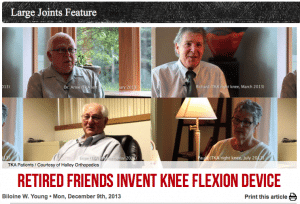 The initial idea, as Anglebrandt explained it, was to improve the straightness of patients’ knees, post-surgery. One patient of Halley’s had made a contraption at home using wood, rope and a plunger to keep his knee straight. Ewing couldn’t bear to see that and set to work building something better. In a short time Halley and Ewing discovered that the device they were working on would also treat “flexion, ” or bendability, not just straightness of the leg. A complication with total knee replacement is that while flexion might be perfect immediately after surgery, it can quickly diminish because a built-up of fluid can cause scarring.
It took the two men several years and $1 million to work through eight variations, but they eventually came up with a machine they liked and registered it with the U.S. Food and Drug Administration. A computer screen displays biofeedback information, mainly angle and pressure readings, so patients can monitor their improvement and adjust the settings. The company rents the machine for however many weeks the patient needs it to restore the knee to an acceptable level of motion. The inventors say it saves money for patients by avoiding nursing homes and reducing physical therapy visits.
Problems with Traditional Recovery (Orthopedics This Week)
As Halley explained, “People would come back in six weeks and have a flexion contracture. It wasn’t that many people but, still, you want 100% because right after surgery everyone could straighten it out.”
The critical extension point for the releasing of fluid is reached at the very last point before real pain is felt, he said. The X10 reaches this point slowly and precisely. A doctor initially sets the X10 to extend the leg to just before the patient feels pain. As flexibility improves, the patient can adjust it to move the leg farther.
The two inventors want their patients to achieve a better range of motion than they had prior to surgery. (Many doctors consider it a success when patients achieve 110 degrees of motion instead of the 130 degrees normally seen in healthy knees.) Some patients use their X10 device three or four times a day in the hope they will achieve superior results. The original “Version 1.0 machine”, which measures a foot and a half wide and about 2 1/2 feet tall, became available initially through outpatient clinics and home care companies.